
Chemical Reactions And Equations:
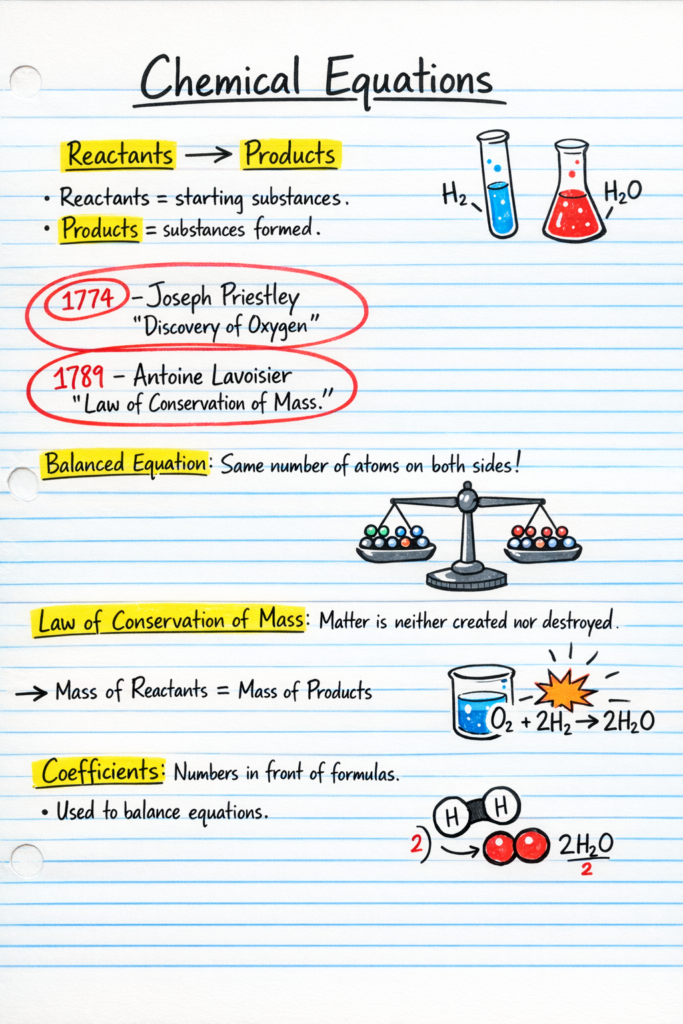
Explanation:
Chemical Equations
1. Reactants → Products
- Reactants are the starting substances in a chemical reaction.
- Products are the new substances formed after the reaction.
A chemical equation is written as:Reactants→Products
The arrow (→) shows the direction of the reaction.
2. Important Historical Contributions
- 1774 – Joseph Priestley discovered Oxygen.
- 1789 – Antoine Lavoisier proposed the Law of Conservation of Mass.
These discoveries helped scientists understand how chemical reactions work.
3. Balanced Chemical Equation
A balanced equation has:
👉 The same number of atoms of each element on both sides of the equation.
This follows the Law of Conservation of Mass, which states:
Matter is neither created nor destroyed during a chemical reaction.
So,Mass of Reactants = Mass of Products
4. Example
O2+2H2→2H2O
This equation shows:
- Oxygen reacts with Hydrogen
- Water is formed
- The equation is balanced because the number of Hydrogen and Oxygen atoms is equal on both sides.
5. Coefficients
- Coefficients are the numbers written in front of chemical formulas.
- They are used to balance equations.
- Example: In 2H₂O, the number 2 is the coefficient.
Quick Revision Points
✔ Reactants → Products
✔ Balanced equation = equal atoms on both sides
✔ Law of Conservation of Mass
✔ Coefficients help in balancing