
Chemical Equations
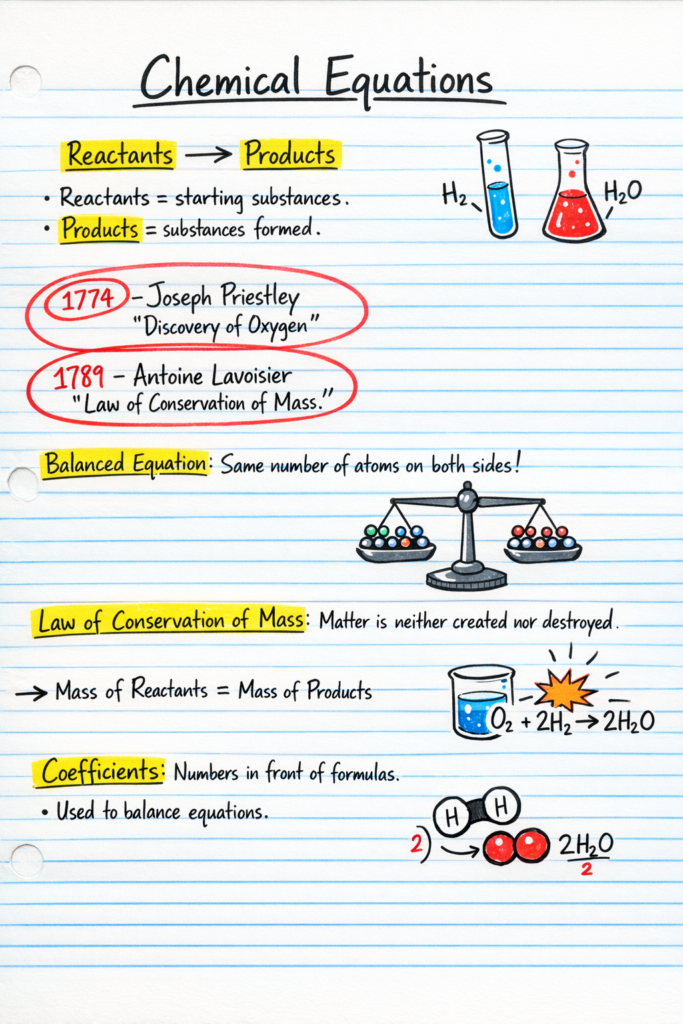
Chemical Equations
1. Reactants → Products
- Reactants are the starting substances in a chemical reaction.
- Products are the new substances formed after the reaction.
A chemical equation is written as:Reactants→Products
The arrow (→) shows the direction of the reaction.
2. Important Historical Contributions
- 1774 – Joseph Priestley discovered Oxygen.
- 1789 – Antoine Lavoisier proposed the Law of Conservation of Mass.
These discoveries helped scientists understand how chemical reactions work.
3. Balanced Chemical Equation
A balanced equation has:
👉 The same number of atoms of each element on both sides of the equation.
This follows the Law of Conservation of Mass, which states:
Matter is neither created nor destroyed during a chemical reaction.
So,Mass of Reactants = Mass of Products
4. Example
O2+2H2→2H2O
This equation shows:
- Oxygen reacts with Hydrogen
- Water is formed
- The equation is balanced because the number of Hydrogen and Oxygen atoms is equal on both sides.
5. Coefficients
- Coefficients are the numbers written in front of chemical formulas.
- They are used to balance equations.
- Example: In 2H₂O, the number 2 is the coefficient.
Quick Revision Points
✔ Reactants → Products
✔ Balanced equation = equal atoms on both sides
✔ Law of Conservation of Mass
✔ Coefficients help in balancing
Chemical Equations (3–4 Marks Answer)
A chemical equation is the symbolic representation of a chemical reaction using chemical formulas.
In a chemical equation:
- Reactants are the starting substances.
- Products are the substances formed.
- The arrow (→) shows the direction of the reaction.
Example:O2+2H2→2H2O
A balanced chemical equation has the same number of atoms of each element on both sides.
This follows the Law of Conservation of Mass (1789 – Lavoisier), which states that matter is neither created nor destroyed in a chemical reaction.
Coefficients are the numbers placed before chemical formulas to balance the equation.
Mass
🔢 Numerical Practice Questions | Download PDF
Q1. Balance the equation:
H2+O2→H2O
Q2. Balance the equation:
Fe+O2→Fe2O3
Q3. Balance the equation:
Al+O2→Al2O3
Q4. If 4 g of Hydrogen reacts completely with Oxygen, how many grams of Oxygen are required?
(Given reaction: 2H2+O2→2H2O)
(Atomic mass: H = 1, O = 16)
Q5. Calculate the mass of water formed when 32 g of Oxygen reacts completely with Hydrogen.
Reaction: 2H2+O2→2H2O
Q6. In the reaction
C+O2→CO2
How many grams of CO₂ are formed when 12 g of Carbon burns completely?
Q7. 56 g of Iron reacts with Oxygen to form Iron(III) oxide. Calculate the mass of Fe₂O₃ formed.
(Balanced reaction required first.)
Q8. In the reaction
2Mg+O2→2MgO
How many grams of MgO are formed from 24 g of Magnesium?
(Atomic mass: Mg = 24, O = 16)
Q9. If 10 g of Calcium reacts with water:
Ca+2H2O→Ca(OH)2+H2
Calculate the mass of Hydrogen gas produced.
(Atomic mass: Ca = 40, H = 1, O = 16)
Q10. Law of Conservation of Mass Based Question
If 15 g of Hydrogen reacts with 120 g of Oxygen, what will be the total mass of products formed?
✅ Solutions to Numerical Questions
Q1. Balance the equation
H2+O2→H2O
Step 1: Count atoms
LHS: H = 2, O = 2
RHS: H = 2, O = 1
Step 2: Balance Oxygen
Put 2 before H₂O:H2+O2→2H2O
Now RHS: H = 4, O = 2
Step 3: Balance Hydrogen
Put 2 before H₂:2H2+O2→2H2O
Q2. Balance the equation
Fe+O2→Fe2O3
Step 1: Balance Fe
Put 2 before Fe:2Fe+O2→Fe2O3
Step 2: Balance Oxygen
Fe₂O₃ has 3 O, O₂ has 2 O → LCM of 2 and 3 is 64Fe+3O2→2Fe2O3
✔ Balanced equation:4Fe+3O2→2Fe2O3
Q3. Balance the equation
Al+O2→Al2O3
LCM of O = 2 and 3 → 64Al+3O2→2Al2O3
✔ Balanced equation:4Al+3O2→2Al2O3
Q4. 4 g of H₂ reacts — Find O₂ required
Balanced equation:2H2+O2→2H2O
Step 1: Molar masses
H₂ = 2 g
O₂ = 32 g
Step 2: From equation
2H₂ (4 g) reacts with O₂ (32 g)
So, 4 g H₂ requires 32 g O₂Answer=32 g of Oxygen
Q5. 32 g O₂ reacts — Find water formed
From equation:
32 g O₂ → 2H₂O
2H₂O = 2 × 18 = 36 gAnswer=36 g of Water
Q6. 12 g Carbon burns — Find CO₂ formed
Reaction:C+O2→CO2
Molar mass:
C = 12 g
CO₂ = 44 g
So,
12 g C → 44 g CO₂Answer=44 g of CO2
Q7. 56 g Fe reacts — Find Fe₂O₃ formed
Balanced equation:4Fe+3O2→2Fe2O3
Molar mass:
4Fe = 4 × 56 = 224 g
2Fe₂O₃ = 2 × 160 = 320 g
So,
224 g Fe → 320 g Fe₂O₃
Given 56 g Fe:224320×56=80 g Answer=80 g Fe2O3
Q8. 24 g Mg reacts — Find MgO formed
Reaction:2Mg+O2→2MgO
2Mg = 48 g
2MgO = 80 g
So,
48 g Mg → 80 g MgO
24 g Mg → ?4880×24=40 g Answer=40 g MgO
Q9. 10 g Ca reacts — Find H₂ formed
Reaction:Ca+2H2O→Ca(OH)2+H2
Molar mass:
Ca = 40 g
H₂ = 2 g
So,
40 g Ca → 2 g H₂
10 g Ca → ?402×10=0.5 g Answer=0.5 g Hydrogen
Q10. Law of Conservation of Mass
Given:
15 g H + 120 g O
Total mass of reactants:15+120=135 g
According to Law of Conservation of Mass:Mass of products=135 g
📌 Final Quick Formula for Numericals
Required mass=Given molar massGiven mass×Required molar mass